

A practical commercial security guide for Australian business owners, facility managers and property teams.
What is a CCTV camera system?
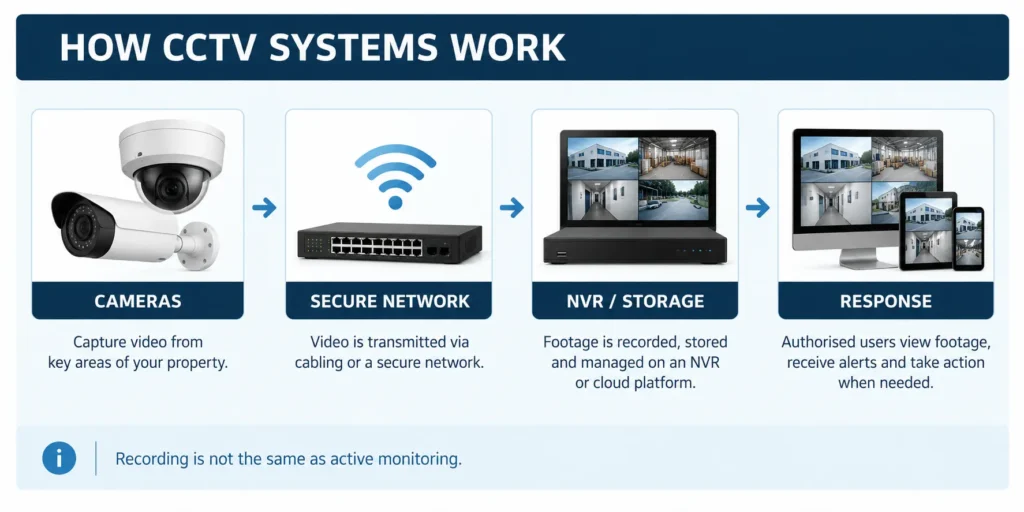
Closed-circuit television (CCTV) is a video surveillance arrangement in which footage is available to a defined group of authorised users. A typical system combines cameras, cabling or network connections, recording equipment, storage and viewing software. Cameras may capture footage continuously, on a schedule or when events are detected.
- Cameras capture video at entrances, exits, perimeters and operational areas.
- NVRs, DVRs or video management software record and organise footage.
- Storage systems retain footage for an agreed period.
- Remote access and alerts allow authorised users to review activity.
- Monitoring and response procedures define what happens when an incident occurs.
Types of CCTV cameras
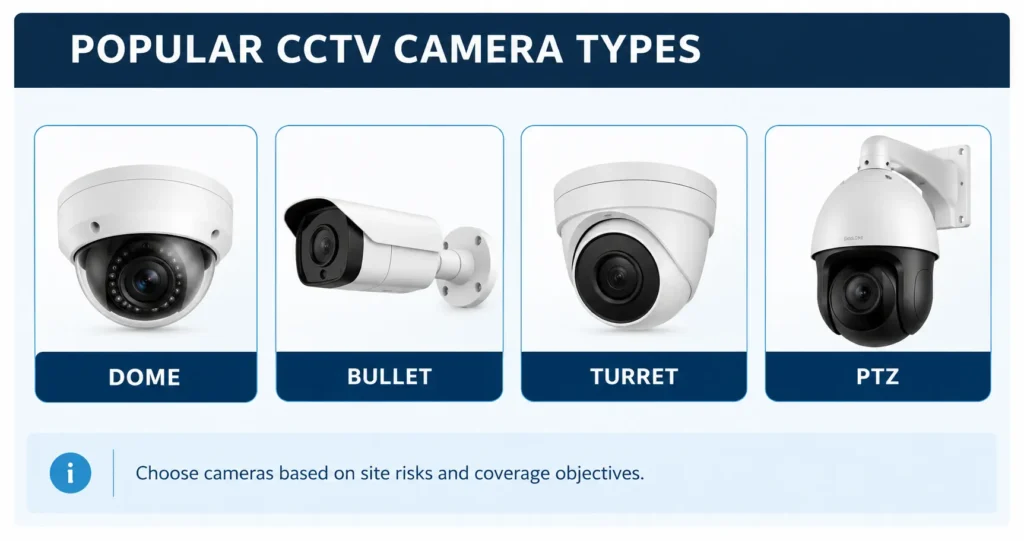
Different camera designs serve different surveillance objectives. A useful camera layout combines wide situational awareness with sufficiently detailed views of high-risk points.
Dome cameras
Compact cameras commonly used in offices, corridors and retail spaces. Vandal-resistant and outdoor-rated models are available. Glare and dirty covers can reduce night image quality.
Typical use: Offices, lobbies, retail.
Bullet cameras
Elongated, visible cameras often positioned at gates, loading docks and external walls. They can deter opportunistic activity but require careful positioning and weather protection.
Typical use: Perimeters, entrances, car parks.
Turret cameras
Adjustable compact cameras suitable for indoor or outdoor use when correctly rated. They offer flexible aiming and a wide choice of lenses and illumination options.
Typical use: Shops, corridors, building entrances.
PTZ cameras
Pan-tilt-zoom cameras let operators redirect and zoom the view. They help investigate large areas, but fixed cameras may still be needed for continuous coverage.
Typical use: Large industrial and logistics sites.
Infrared and low-light cameras
Infrared illumination supports imaging in dark conditions; specialised low-light sensors work with limited ambient light. Performance depends on distance, reflections and lighting.
Typical use: After-hours security.
Thermal cameras
Detect thermal radiation rather than normal visible-light detail. Useful in specialised perimeter applications but typically less suitable for facial identification.
Typical use: Specialised perimeter detection.
Fisheye cameras
Very wide viewing angles provide broad situational awareness. Distant subjects may lack sufficient identifying detail.
Typical use: Open-plan areas.
| Camera type | Strength | Important limitation |
|---|---|---|
| Dome | Compact appearance | Cover reflections |
| Bullet | Visible deterrent | Exposed placement |
| Turret | Flexible aiming | Careful mounting |
| PTZ | Active zoom and tracking | One viewing direction at a time |
| Low-light | After-dark recording | Range and illumination |
| Thermal | Thermal detection | Limited identifying detail |
| Fisheye | Wide-area view | Reduced distant detail |
IP CCTV vs analogue CCTV
IP cameras transmit digital video across a network and commonly connect to an NVR or video management system. Analogue and HD-over-coax cameras use compatible coaxial infrastructure and a DVR. A modern IP solution can be attractive for new commercial deployments, while existing coaxial wiring may make a compatible upgrade economical.
| Feature | IP CCTV | Analogue / HD-over-coax |
|---|---|---|
| Transmission | Network data | Coaxial video |
| Recording | NVR / VMS | DVR |
| Power | PoE or separate | Separate or compatible coax power |
| Expansion | Network and licensing capacity | DVR channels and cabling |
| Cybersecurity | Network controls essential | Remote-access components also need protection |
| Good fit | New scalable installations | Existing suitable coax installations |
Essential CCTV features to compare
Resolution and lens
More pixels do not guarantee usable evidence. Evaluate distance, field of view, lighting, compression and mounting height.
Night performance
Test realistic lighting, infrared range, reflective surfaces and exposure settings.
Storage and retention
Plan capacity using camera count, bit rate, recording schedule and the organisation’s retention policy.
Remote access and security
Use strong authentication, least-privilege permissions, secure network access and supported firmware.
Analytics and alerts
People/vehicle detection and virtual boundaries can assist review but can also create false positives.
Reliability
Assess backup power, equipment health alerts, network resilience and routine testing.
How much do CCTV camera systems cost in Australia?
There is no reliable single price for all commercial CCTV projects. Equipment, cabling, site access, recorder capacity, installation complexity and monitoring arrangements all change the quote. Ask suppliers for a written scope and itemised whole-of-life costs rather than comparing camera prices alone.
| Cost driver | What to check |
|---|---|
| Camera count | Coverage plan and blind spots |
| Camera specification | Lens, resolution, night vision, weather rating |
| Cabling and installation | Distances, mounting and access equipment |
| Storage | Retention, redundancy and recorder capacity |
| Network security | PoE switching, authentication and remote access |
| Ongoing service | Maintenance, monitoring and support |
Strengthen your business security
Discuss your CCTV and commercial security requirements with MBK Security Group.
CCTV by business environment
Retail and shopping centres
Prioritise entrances, sales areas, stockrooms and incident review while protecting customer and employee privacy.
Warehouses and logistics
Consider loading docks, gates, valuable inventory zones, vehicle access and after-hours perimeter activity.
Corporate offices
Focus on reception, access-controlled entrances, shared areas and parking rather than unnecessary surveillance of staff.
Construction sites
Review temporary camera positions as access routes and high-value storage areas change.
Healthcare and education
Apply heightened care to sensitive spaces, vulnerable individuals, privacy and restricted footage access.
CCTV recording vs active monitoring
Recording means footage is captured for later review. Active monitoring means authorised personnel or a monitoring provider review selected live feeds or alerts under defined procedures. Neither approach automatically guarantees that someone can respond immediately.
| Recording | Monitoring |
|---|---|
| Preserves video evidence | Supports alert review and escalation |
| May operate without a live operator | Requires an agreed operating model |
| Incident review may occur later | Can support earlier incident detection |
| Response not inherent | Response depends on personnel and procedures |
CCTV laws and privacy in Australia
Surveillance rules vary across Australian states and territories. Organisations should assess the purpose and proportionality of surveillance, signage and notices, employee notification requirements, access controls, audio recording restrictions and retention practices. The Australian Privacy Principles may also apply to covered organisations. Obtain location-specific advice before installation.
Primary references: OAIC: Security cameras and OAIC: Workplace monitoring and surveillance.
Eight-step CCTV selection checklist
Identify site threats and operational priorities.
Map entrances, exits, blind spots and lighting conditions.
Define whether each camera must detect, observe, recognise or identify.
Select appropriate camera types, lenses and mounting positions.
Specify storage, retention, backups and access permissions.
Review privacy and workplace surveillance obligations.
Document alert escalation and physical response procedures.
Schedule routine testing, cleaning and software maintenance.
Common mistakes to avoid
- Choosing cameras solely by megapixel count.
- Mounting cameras too high to capture useful details.
- Ignoring night-time glare, backlighting and blind spots.
- Leaving default passwords or exposing recorders insecurely.
- Assuming recorded footage is actively monitored.
- Underestimating storage and maintenance requirements.
- Failing to review privacy rules before installation.
Why CCTV should be part of an integrated security strategy
CCTV improves visibility and supports investigations, but cameras cannot physically control entry, help visitors or respond on site. Commercial properties may need CCTV alongside alarms, access control, security guards and mobile patrols. The right combination depends on site risks, operating hours and response requirements.
Related MBK services: Security services and mobile patrols.
Frequently asked questions
What is the best CCTV system for a business?
The best option depends on the property layout, lighting, security objectives and budget. Many commercial sites benefit from a carefully designed IP system with secure recording and clear response procedures.
Can CCTV work without internet?
Yes. Many wired systems can record locally without internet access; cloud functions and remote viewing may require connectivity.
Is 4K better than 1080p?
4K provides more pixels, but usable footage also depends on lens choice, distance, lighting and compression.
What is the difference between NVR and DVR?
An NVR typically manages network IP camera recordings; a DVR generally records compatible analogue or HD-over-coax feeds.
Do CCTV cameras record all the time?
Systems may record continuously, on a schedule or when motion or other events are detected.
How long should footage be kept?
Retention depends on business needs, storage capacity and applicable legal requirements; there is no universal period for every site.
Can CCTV replace security guards?
No. CCTV supports observation and evidence, while guards can perform physical access control, assistance and incident response.
Do CCTV cameras need maintenance?
Yes. Clean lenses, check angles, verify recordings and alerts, review storage health and keep supported software current.
How many cameras does a business need?
A site survey and coverage plan are needed; floor area alone does not determine camera count.
Is CCTV monitoring worthwhile?
It may be valuable when a business needs timely alert review and an agreed incident escalation process.
Protect your business with a coordinated security plan
The most effective CCTV investment starts with clear objectives: what needs protecting, what footage must show and who will respond when something happens. MBK Security Group can discuss security requirements and how CCTV relates to guarding, mobile patrols and broader site protection. Confirm service scope and availability during consultation.
Strengthen your business security
Discuss your CCTV and commercial security requirements with MBK Security Group.
